OpenAN is an open, vendor-neutral framework for end-to-end autonomous networks. It accelerates cross-layer, cross-domain integration of telecom-specific agents and enables multi-agent collaboration so global operators can deploy AN with efficient orchestration and interaction.
OpenAN brings the operators, vendors, and innovators of the telecom industry together around shared standards, shared skills, and a shared roadmap toward Autonomous Networks Level 5.
Accelerate cross-layer and cross-domain integration and deployment of telecom-specific agents. OpenAN enables multi-agent collaboration so global operators benefit from efficient orchestration and interaction across the AN stack.
See the architecture →Grounded in industry standards (SPG, A2A-T, intent API), OpenAN promotes vendor-neutral, scenario-based skills, components, knowledge, and practices. A collaboration ecosystem across the whole telecom industry collectively enhances AN capability.
Join the community →OpenAN aims to be the de facto standard for autonomous network operation in telecom, and to explore integration and collaboration for the next generation of intelligent systems aimed at AN L5.
View the roadmap →OpenAN sits between the service layer (OSS copilots, optimization and fault agents) and the network layer (RAN, fixed access, IP, core). The A2A-T SDK extends Google's A2A protocol with telecom-grade primitives so agents in either layer can register, discover, negotiate, and act safely on the network.
Explore the components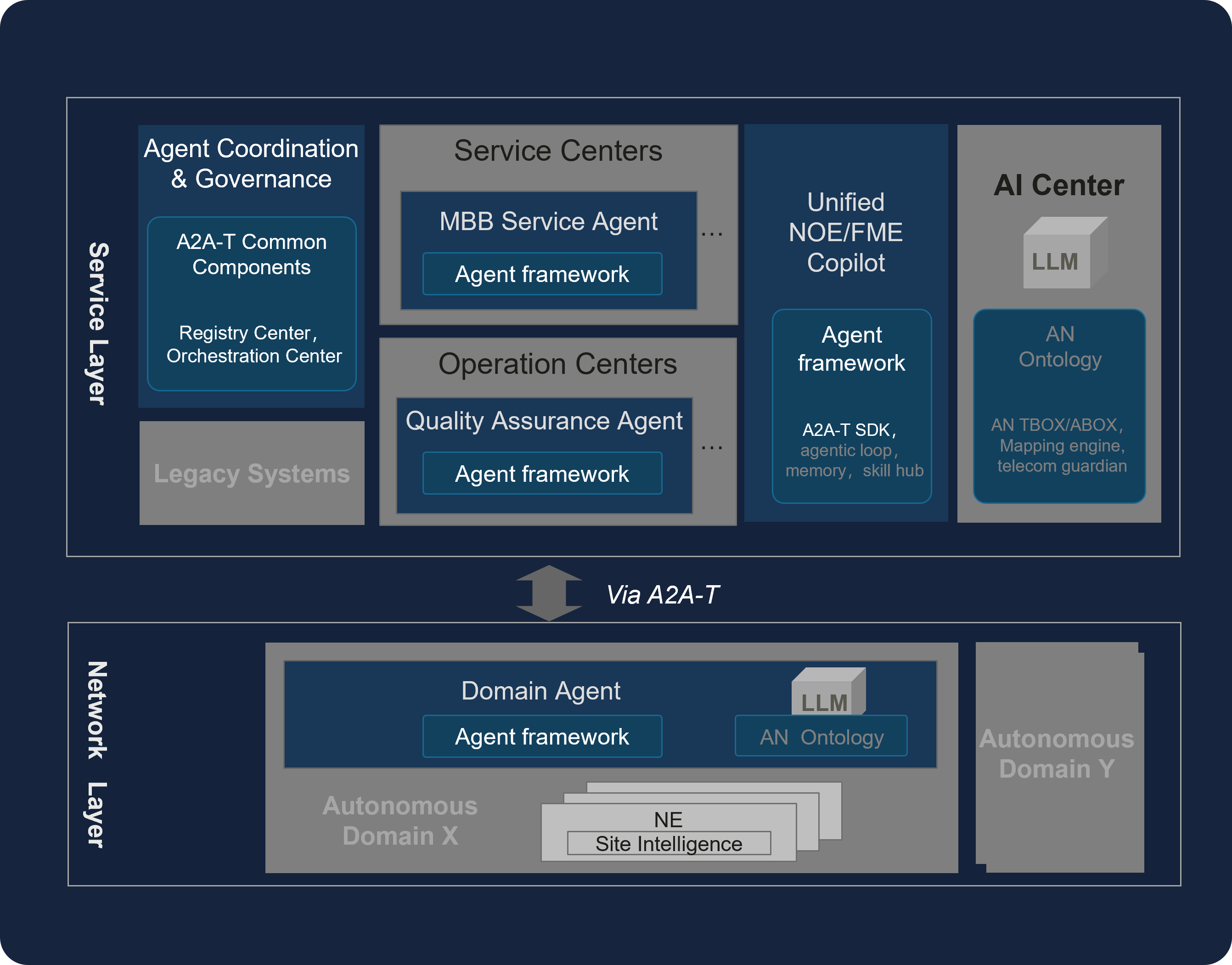
In June 2026 at DTW-Copenhagen, OpenAN open sources its three seed components. From September to December, scenario-based solution packages are released through joint innovation with operators.
A telecom-grade extension of the A2A protocol, designed for deterministic, network-scenario-compliant cross-layer agent collaboration. Supports JSON-RPC and HTTP+REST.
The "agent labor market" — a yellow-pages service that finds and manages agent addresses, registers skills, handles health management, and uses LLM-aided retrieval to map intents to the right agent.
A hub that orchestrates agents into reliable, reusable workflows via a workflow canvas, condition editor, property manager, and a workflow market — bridging manual design and autonomous programming.
A2A is the foundation for inter-agent communication. For telecom, A2A-T adds four extensions so agents can describe tasks precisely, share network events efficiently, negotiate around ambiguity, and act on the network only with explicit authorization.
When a customer calls in with "no internet for two days" or "YouTube is slow", OpenAN orchestrates the right agents end-to-end — billing, CDN, RAN, and vendor-specific fault agents — and hands off to a human expert only when needed.
The Home Broadband Complaint Handling Agent recalls a workflow from the Orchestration Center, retrieves the matching agents from the Registry Center, and coordinates them over A2A-T.
Different complaints trigger different workflows: a billing issue invokes the customer-care and billing agents; a CDN issue invokes customer-care, the CDN agent, and a vendor FAN agent.
OpenAN launched at MWC-Barcelona in March 2026 and open sourced its seed code, donating to LF Networking in June 2026 at DTW-Copenhagen. Commercial verification is planned through 2027.
China Mobile and Huawei announce OpenAN; development and verification begin in earnest.
A2A-T SDK, Registry Center, and Orchestration Center are open sourced and donated to LF Networking.
Scenario solution packages and more contributors join; OpenAN is positioned as an Innovation Hub Pioneer Project.
Startup member review, ongoing maintenance, and commercial verification of OpenAN deployments by operators.
OpenAN is being built by China Mobile and Huawei at kickoff, with more partners joining through 2026. Whether you operate a network, build network equipment, or research autonomous systems — there is a seat for you.
All OpenAN repositories live in the project-openan GitHub organization. The seed code import is in progress; watch the org for new repos as they land.
View the org →Real-time discussion on the LF Zulip. Subscribe to #lfn-openan-discussion, #lfn-openan-support, and #lfn-openan-tsc.
Project documentation, meeting notes, and working-group structure are coming as the project organizes. Community calls will be open to everyone.
Contribute here →The TSC oversees design and development, sets release and quality standards, mediates technical conflicts, and organizes inter-project collaboration. An Adopter Advisory Committee (AAC) provides industry input.
View governance →The documentation repo is live. Getting-started guides, A2A-T reference docs, and scenario playbooks are published in the project-openan GitHub organization.
Read the docs →OpenAN mailing lists for the TSC, developers, and announcements are hosted on Groups.io. Subscribe to stay in the loop.
Browse the lists →OpenAN is a candidate LFN project. The seed code is now available in the project-openan GitHub organization. The fastest way to get started is to read the charter, clone the repos, and join the community on Zulip.
Start with the OpenAN Technical Charter to understand governance, scope, and how contributions are accepted.
OpenAN Technical Charter 06-22-2026.pdf
The three seed components are live in the project-openan GitHub organization. Clone them, browse the code, and open issues or pull requests.
github.com/project-openan/a2a-t-sdk-python
github.com/project-openan/a2a-t-sdk-java
github.com/project-openan/registry-center
github.com/project-openan/orchestration-center
Real-time discussion happens on the LF Zulip. Subscribe to the community, support, and TSC channels.
#lfn-openan-discussion
#lfn-openan-support
#lfn-openan-tsc
Contributions are accepted under Apache 2.0. Each commit needs a Developer Certificate of Origin sign-off (git commit -s), and EasyCLA prompts you to sign the Contributor License Agreement on your first pull request. Both checks run automatically.
Apache 2.0 . DCO . EasyCLA
The Technical Steering Committee (TSC) oversees design and development activities, sets release and quality standards, mediates technical conflicts, and organizes inter-project collaboration across the OpenAN ecosystem. An Adopter Advisory Committee (AAC) provides input and industry perspective.
Project Roles. TSC Chair and Co-Chair, TSC Voting Members, Adopter Advisory Committee (AAC) members, committers, maintainers, and contributors.
How roles are filled. Defined in GOVERNANCE.md and CONTRIBUTING.md. Removal is by TSC vote.
Dispute resolution. The TSC mediates technical conflicts, with decisions reached by majority vote. The TSC is the body to which the LFN TAC looks for interfaces.
Charter evolution. Governance evolves through changes to the Charter, approved by the TSC.
Subscribe to OpenAN updates, release announcements, community meeting notes, and how-to-contribute posts. Or jump straight to the code and the Zulip channels.